Like I've mentioned before, Warhammer is another one of those franchises that I've always been curious about, but never really dug into. However, after watching a handful of lore videos (courtesy of Bricky), I've started to take a closer look at the 40K side of things. Among the hundreds of available novels, The Horus Heresy was recommended as a good starting point, with the first three making a loose trilogy, so I decided to give it a shot.

by Dan Abnett
Set a good 28,000 years in the future (but still 10,000 years before the setting's current time), the Imperium of Man is eager to reconquer the stars in what they call The Great Crusade. While having many factions in his military, the Emperor of Mankind has focused his efforts on the legions of Space Marines being handled by his artificial sons known as the Primarchs. However, the Emperor decides to head back home to Terra (Earth), leaving the Crusade to his favorite "son" Horus, giving him the title of Warmaster. Horus himself has four advisors which he calls The Mournival, and when a slot opens up, the dedicated but thoughtful captain Lokan (who is our main character) is given the opportunity to fill it. He hesitates, but eventually takes it on the encouragement of those he trusts, allowing him to see triumphs and troubles of Horus up close. The book has three loosely connected sections, first focusing on a planet that the Imperium has conquered in the name of "correcting" its people to the Emperor's ways (which leads to some moral ambiguity). Second is another planet featuring some very fierce monsters, and when another Legion gets reckless, Horus and his Luna Wolves have to go bail them out. This leads to a third section involving another branch of humans called the Interex who have had their own multi-world kingdom and the diplomatic problems it presents.
The narrative reads well enough. Abnett does a good job of humanizing these super soldiers, partially by bringing along a handful of space journalists to document their efforts. Most of the action features pretty typical sci-fi military tropes, but they're done well, not only showing the power of the Space Marines, but also of their enemies as both sides are slaughtered. However, the grim dark atmosphere makes it hard to really be invested in the stakes. Even if Horus and his armies win, the cost is still debated and victories are turned bitter-sweet by the events as they unfold. (I also wonder if by watching those aforementioned lore videos that I've already spoiled myself for most of what happens here, so reading these has been a curious, and slightly morbid, exercise in dramatic irony.)
That being said, the book doesn't exactly stand on its own but is largely a lot of set up for the tragedies that follow. Early on, Lokan has an experience with a demon from the warp, and he is troubled by this because according to Emperor, things like demons and evil spirits shouldn't exist. Later, he's told by Horus that it wasn't really a supernatural thing, just an accident of the warp, but his doubts linger. Eventually, this sets up the wedge that will cause the entire legion to start worrying about what the Emperor says is the truth and what they experience, affecting even Horus himself.
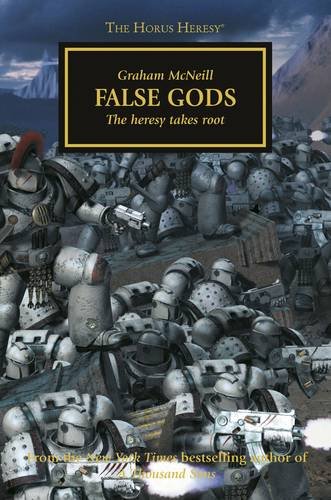
by Graham McNeil
Picking up a few weeks after the diplomatic disaster with the Interex, Warmaster Horus and his legion are called back to a planet they had conquered decades before. At first, they're not sure why Erebus of the Word Bearers has them coming back, but eventually he explains that the Imperial Governor they had left there had turned traitor, spitting on the name of Horus and the Emperor of Mankind. Furious, Horus brings his men to the moon of Davin, only to discover it has transformed into a marsh filled with the undead. Not used to fighting such a force, they seek to find out what caused it, only to find more mysteries and Erebus's manipulations!
For what it's worth, I don't really notice much of a difference in writing style with the new author. I did learn that the two of them worked together on the series (along with the others), and I'm sure they were checking each other's notes, so maybe this isn't much of a surprise. However, this book definitely feels more complete, as each section builds on the previous quite well, leading to a very critical and climactic decision. I will say that the journalists are starting to get distracting at this point, though they do have a role to play, and there is a shift into melodrama, but this is largely a consequence of the raising of the stakes. When the Warmaster is mortally wounded (something everyone considered an impossibility), the Mournival are split on what to do, with some of them choosing to rely on Erebus's plan to use dark magics to revive him, despite Lokan arguing otherwise. Horus is successfully revived, but he isn't quite the same anymore, and before long, it's clear that he is being manipulated by forces of Chaos to turn against the Emperor by seeking his own ambitions, while Lokan worries about what will happen to the legion he's a part of and if it really is changing for the worse.
I think I did like this one a little more than the first, if only because it felt a little more organized in what it was doing. I get that part of the Great Crusade really is just going from planet to planet and letting the Space Marines do what they do best, making things feel a little episodic, but with this one, McNeil is able to build the tension to a very tragic climax as the titular heresy develops. Once again, I worry that my foreknowledge is coloring my views, but I understand that even the fans of this franchise knew the basics going in, as this story takes place in the setting's past. I can't deny that watching this tragedy unfold has been pretty compelling, at the end of this one, so I was eager to get into the next book.
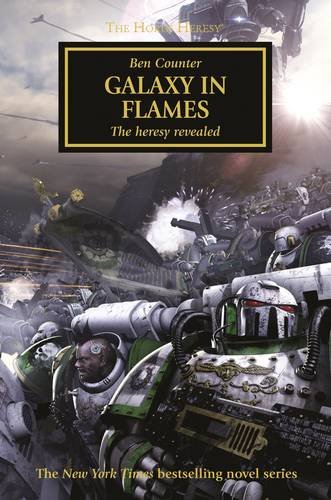
by Ben Counter
Sure enough, Horus's descent starts here and while it may feel inevitable, it's hard not to find the narrative engaging nonetheless. This time, Horus has conspired with a handful of other legions to go attack another world named Isstvan III, which had been conquered before but turned traitor. Known for their warsingers and their powerful voices, the battle is difficult, but it only seems to provide opportunities for the traitor legions to start experimenting with their new chaos-founded powers. In the midst of this, the various characters we've come to know so far start picking sides, with Lokan in particular confronting the rest of the Mournival and discovering just how deep the conspiracy goes! Unfortunately, all the soldiers Horus has sent to Isstvan III are ones he can do without, getting rid of those who would stand in his way, even if they were his own men!
Ben Counter picks up the narrative easily enough (and likely was working with the other two authors in the meantime), so there isn't any kind of jarring shift in style or expression. He does a very good job of setting up the circumstances so that we can all watch the slow-motion train wreck with morbid anticipation. It's also nice to see many characters who were introduced in the first book be relevant in this one, helping tie these novels closer together. Once again, things build up well, reaching a mostly satisfying conclusion. However, I will say that I think Horus's great betrayal plan does feel a little cheesy. Sending the soldiers he doesn't like to the surface only to bomb them afterwards sounds a bit cartoony, when I think the betrayal could have been much more than that. Sure, we get the tragedy of brother killing brother, and the death toll certainly sky rockets as every side of the battle gets slaughtered one way or another. However, I'm not quite sold on how the events of this book are supposed to kickstart the Heresy on a grander scale (at least not yet).
Still, I liked what I read, and enjoyed many of the characters featured here, especially as they make their various choices now that the chips are down. The development of the religion cult dedicated to the Emperor, which started with a few but has now grown to quite the congregation, makes for an interesting parallel, as some characters become more devoted to the Imperium while the Chaos Legions grow their power. A solid book, even if it feels like just another chapter of the much bigger narrative.
These are just the first three books in a very long series called The Horus Heresy, which is over 60 books long! While I did enjoy most of what I read here, I don't know if I'm going to carry on through the whole thing. These three set the stage for the rest of the non-linear series, but the grim dark nature makes me hesitate, as I'm not always fond of it. Still it was engaging to see how the infamous Horus Heresy started, and I know there are other corners of this franchise I could check out. But for now, I'm largely satisfied that I've merely dipped my toes in this vast ocean of Warhammer 40,000.
No comments:
Post a Comment